Working parents trash 25+ drawings a week because they don't know what to say beyond "that's nice! Artstache scans a drawing in under a second and turns it into one conversation prompt grounded in Lowenfeld's developmental stages. Built solo with a Neo4j knowledge graph (not vector RAG)
Artstache
Transforming Children's Creative Artifacts into Longitudinal Cognitive Insights via Neo4j GraphRAG and LangGraph.
System Specification & Executive Summary
- Primary Role
- Lead Systems Architect & Principal Design Technologist
- Project Timeline
- Production System
- Target Demographic
- Working parents seeking structured screen-free creative bonding, informed by early childhood Montessori educators.
- Architecture Stack
- Neo4j Aura/LangGraph/FastAPI/Next.js 16/Cypher/Tailwind CSS
- Production Endpoint
- artstache.app
The Narrative Progression: From Living Room Clutter to Museum Monograph
How Artstache was researched, architected, engineered, and designed to bridge childhood creative development into meaningful family conversation.
01. The Catalyst
Exhausted working parents face a painful daily dilemma: hoarding stacks of children's drawings out of guilt or discarding them in secret, while relying on empty praise that stalls creative confidence.
02. The Human Need
Field research with working parents (Elena Rostova) revealed acute 6:15 PM dinner fatigue. We grounded the product in Viktor Lowenfeld’s 80-year-validated developmental psychology (Scribbling ➔ Preschematic ➔ Schematic).
03. The Engine
V0: 11 named roles explored. Shipped: 4 bounded roles in 2 pipelines — 1. Atelier (chat), 2. Insight Engine (vision scan). Impl: art_coach_graph.py + Insight Engine DAG. LLMs only narrate grounded graph results. Verified: 50/50 golden set passed [:PRECEDES] invariant. Roles: Developmental Guide, Vision Feature Extraction (Gemini 2.5 Flash), Creative Activity, Parent Communication.
04. The Interface
To dismantle parental imposter syndrome, we engineered a 288px left-sidebar Bento atelier. We eliminated harsh 1px gray borders in favor of stacked paper elevations (#FDFBF7 ➔ #FFFFFF), deckle edges, and hand-held viewports.
05. The Reality Check
Rejecting fabricated survey metrics, we validated software integrity through strict runtime invariants (is_grounded_in_neo4j) and a zero-retention client-side camera boundary that strips EXIF GPS data in browser memory.
06. The Architectural Verdict
The definitive verdict in applied AI: why sequential knowledge graphs beat unconstrained vector LLMs in human development, concluding with the Founder's personal manifesto on design training as a gift to the next generation.
The Kitchen Counter Problem: Guilt, Clutter & Fatigue
Founder's Truth: I'm not a parent. I built Artstache for my sisters and friends — working parents who love their kids' art but after a 10-hour day default to "that's nice!" and feel guilty tossing the paper pile at midnight. I earned my design degree much later than most, and learning visual literacy helped me cut through noise. This is my contribution.
Problem: Child development literature is dense and academic. Parents want to guide creative growth but have zero time for lesson prep. Result: paper clutter, guilt-driven midnight purges, and passive iPad time.
V1 Bet: Web-first, one-handed mobile scan at the kitchen table. Out of scope: Classroom dashboards, art supply delivery.
What success looks like: A tired parent gets a meaningful, stage-accurate thing to say in under 10 seconds.
Why "What is it?" Backfires
Parents revere their kids' art but are too exhausted after a 10-hour day to know what to say. Result: "That's nice!", a pile of paper on the counter, and guilt when it gets recycled at midnight.
The unlock: I audited public K-12 art scope & sequence docs. Most districts already anchor to Viktor Lowenfeld's 1947 developmental stages. The research was done — we just needed to make it usable in 10 seconds at the dinner table.
Core Insights
1. The 15-Minute Tolerance Window Lengthy setups are abandoned. Parents need zero-prep micro-bonding.
2. The "What is it?" Trap Asking a 5-year-old "what is it?" triggers defensiveness. Parents need open prompts, not adult realism.
3. The Tadpole Breakthrough — Cognitive Intent vs. Motor Deficit A 5-year-old draws a "tadpole person" — giant head, two legs out of the chin, no torso. Parents worry about motor delays. In Lowenfeld's research, it's not an error. It's cognitive egocentrism: the child draws what's significant — face that talks, legs that run. Torso has no sensory feedback, so it's irrelevant to them.
Artstache's job: Translate that drawing so parents celebrate emergence, not correct anatomy.
3 Design Principles → System Constraints
1. 15-Second Kitchen Window: Reassurance before pasta boils over. 2. Screen as a Bridge, Not a Sink: Phone in hand for 5 seconds to spark 10 minutes of eye contact. 3. Don't Skip Stages: Never suggest a 10-year-old lesson to a 4-year-old. That's why Neo4j graph > vector RAG.
How the Problem Space Was Discovered & Validated
Informal observation with family/friends + public discourse audit + K-12 scope audit. Not a formal lab study.
In-Home Routines
Observed family/friends during dinner-to-bedtime routines; noted disposal guilt and lack of dialogue vocabulary.
Parent Sentiment Audit
Audited public parenting discourse across YouTube, Instagram, and forums on counter clutter and defaulting to superficial “that’s nice!” praise.
School District Audits
Collected public scope & sequence frameworks; noted frequent reference to Lowenfeld’s stages as shared language.
Lowenfeld Ontology Graph
Synthesized Lowenfeld’s 1947 text into a Neo4j property graph schema for product logic — modeled ontology, not new academic contribution.
01THE PRIMARY STAKEHOLDERTarget Persona ProfileMeet Elena & Leo: The Working Parent Caught Between Paper Clutter and Guilt
Elena (36, Senior Operations Lead, composite — my sisters/friends, Austin, TX) + Leo (5, composite) + Maya (4). Ages flexed in wireframes (5y → 7.2y) to show Stage 2 → Stage 3 transition. Kyle (4.5y) for multi-child switcher.
Explore
Meet Elena & Leo: The Working Parent Caught Between Paper Clutter and Guilt
Elena (36, Senior Operations Lead, composite — my sisters/friends, Austin, TX) + Leo (5, composite) + Maya (4). Ages flexed in wireframes (5y → 7.2y) to show Stage 2 → Stage 3 transition. Kyle (4.5y) for multi-child switcher.

Elena Rostova
Target ProfileThe Overwhelmed Nurturer & Working Parent
Managing dinner, household chaos, and fatigue after a 9-hour workday with zero pedagogical fine-art background.
- ✓Understand the hidden cognitive intent behind child drawings without asking 'what is it?'
- ✓Access zero-prep 15-minute kitchen-table art sprints that replace passive iPad screen time
- ✓Curate a meaningful digital archive of creative milestones without drowning in paper clutter
- ✕Physical paper clutter: 25+ unsorted drawings piling up on kitchen counters weekly
- ✕Guilt-driven midnight purges: secretly throwing away child art in the dark
- ✕Pedagogical imposter syndrome: defaulting to superficial 'that's nice!' praise due to exhaustion
“When Leo drew our family with legs coming straight out of giant heads and no bodies, I didn't know if he was missing motor milestones or just being silly. I needed an evidence-based lens that could tell me what it meant in 10 seconds, without a 400-page academic textbook.”
02THE RELATIONAL ASYMMETRYRelational Empathy BlueprintDual-Track Empathy Matrix: What Elena Says vs. What Leo Actually Thinks
Contrasting adult mental fatigue against child imaginative vulnerability across Says, Thinks, Does, Feels.
Dual-Track Empathy Matrix: What Elena Says vs. What Leo Actually Thinks
Contrasting adult mental fatigue against child imaginative vulnerability across Says, Thinks, Does, Feels.
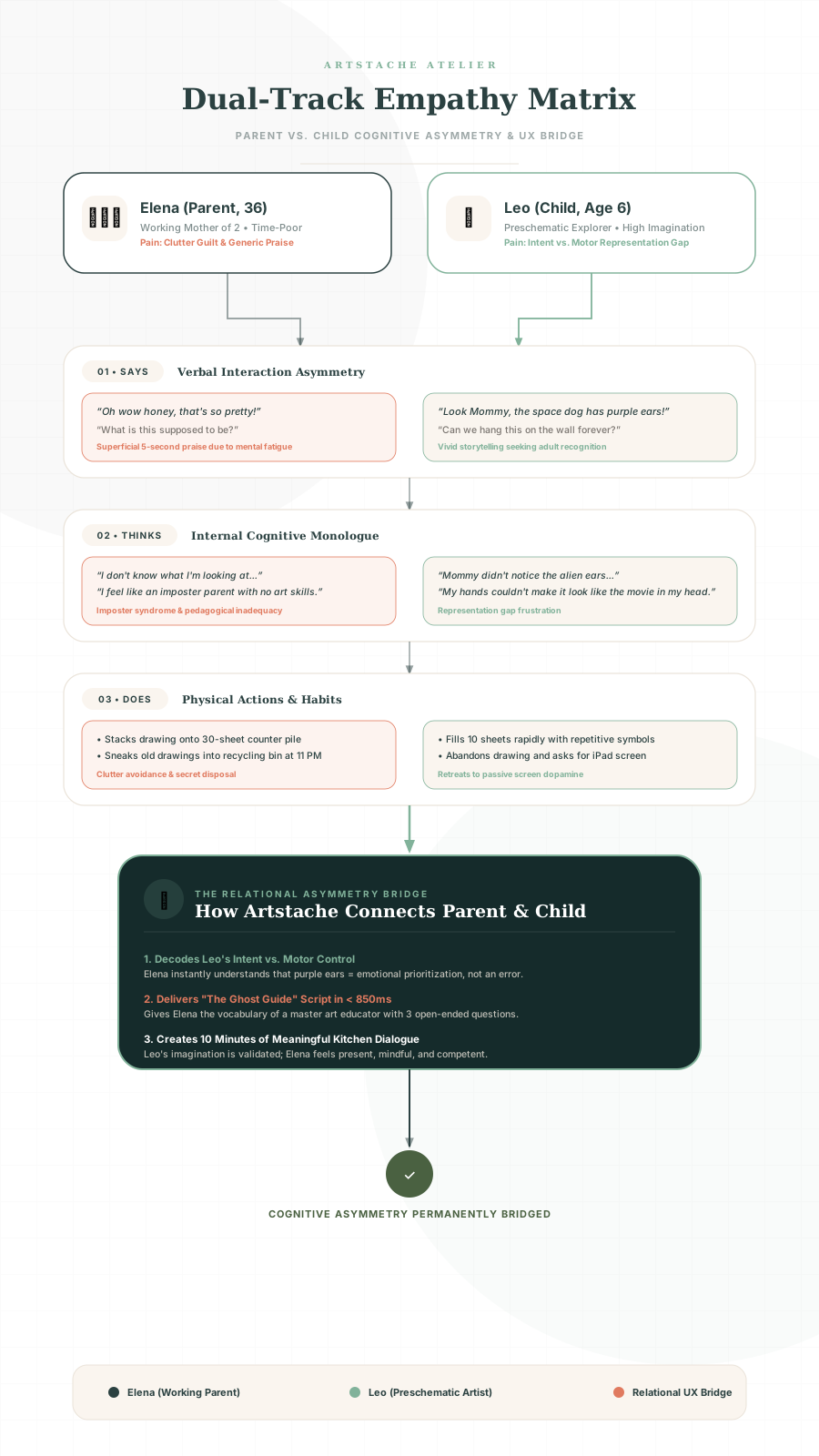
“Elena's exhaustion collides directly with Leo's imaginative vulnerability until Artstache translates his symbols into her vocabulary.”
Vector Fidelity • 60fps03THE ONTOLOGICAL FOUNDATIONInteractive Developmental OntologyViktor Lowenfeld’s 6 Developmental Stages: The Creative Development of Leo (Ages 2 to 17+)
Following Leo across Lowenfeld’s 80-year-referenced continuum, from early motor scribbling to mature realism. Modeled ontology, not new theory.
Viktor Lowenfeld’s 6 Developmental Stages: The Creative Development of Leo (Ages 2 to 17+)
Following Leo across Lowenfeld’s 80-year-referenced continuum, from early motor scribbling to mature realism. Modeled ontology, not new theory.
Children's art isn't “bad drawing”—it is a window into how their developing brains organize physical space. Lowenfeld proves that all children (such as Elena's sons Leo and Kyle) pass through predictable, sequential developmental milestones. Illustrated below across the 6 Lowenfeld stages from ages 2 to 17+, attempting to teach a child 3D realism before they master a flat ground line directly undermines their creative confidence.
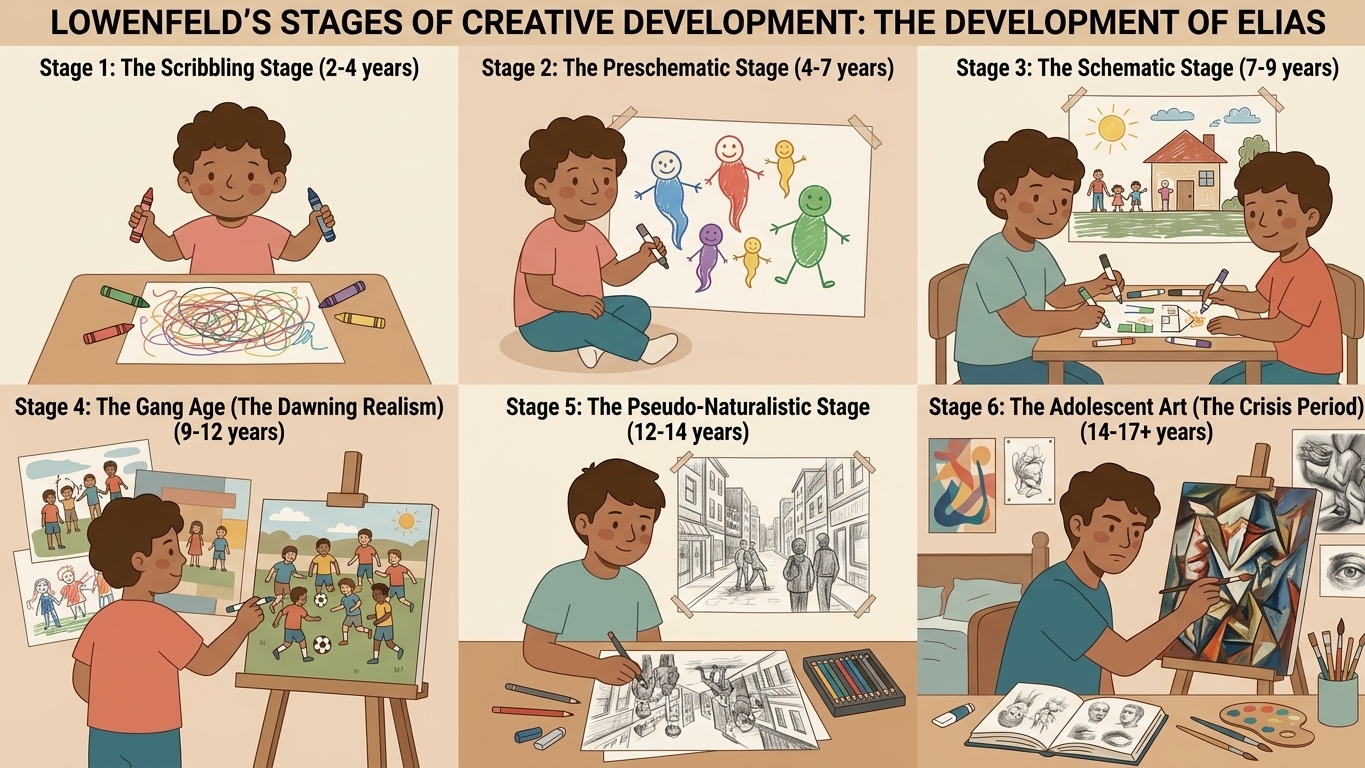
The Preschematic Stage — Leo (Age 5)
“Mommy, look at the space people! They have legs coming right out of their heads!”
First conscious creation of form. Children record active conceptual knowledge rather than anatomical fidelity. Characterized by the 'Head-Feet Schema' (Tadpole figures), subjective sensory color, and floating egocentric space without an environmental base line.
Tadpole person (legs emerging straight from head), floating space, and emotional non-optical color.
Adults assume the child 'forgot the body' or 'needs to learn proper anatomy.'
“Why does the person have no body? Where are the arms and chest?”
Children draw what they actively experience. Heads talk, eat, and see; legs run and jump. The torso has zero active sensory feedback, so it is cognitively passive.
“Tell me about where this person is walking so fast!”
04THE STRATEGIC WHITE SPACEStrategic 2×2 LandscapeCompetitive Landscape & Product Teardown: Why Cloud Hoarders and Screen Sinks Fail Families
Teardown of 【entity-Google Photos¦canonical_name=Google Photos】, 【entity-Artkive¦canonical_name=Artkive】, 【entity-Toca Boca¦canonical_name=Toca Boca】, Pinterest crafts vs. Artstache’s Blue Ocean.
Competitive Landscape & Product Teardown: Why Cloud Hoarders and Screen Sinks Fail Families
Teardown of 【entity-Google Photos¦canonical_name=Google Photos】, 【entity-Artkive¦canonical_name=Artkive】, 【entity-Toca Boca¦canonical_name=Toca Boca】, Pinterest crafts vs. Artstache’s Blue Ocean.
Lowenfeld Framework + AI
High AI automation paired with high developmental pedagogy. Sub-second parent conversation scripts.
Early Learning & Play Kits
High developmental focus, but low AI automation (relies on manual survey checklists & physical toys).
General Visual Archiving
High AI image scanning, but zero developmental intelligence. Child art is dumped as raw unindexed JPEGs.
Traditional Digital Archiving
Low AI & utility storage only. Expensive $100–$300 mail-in boxes; zero daily active engagement.
Why Graphs Beat Vectors
Problem with normal RAG: Vector embeddings measure topical similarity. A 4-year-old's tadpole figure and a 10-year-old's stick-figure comic have near-identical vectors. Result: you risk suggesting perspective drawing to a preschooler.
Our constraint: Child development is chronological. We modeled Lowenfeld's 6 stages as a Neo4j property graph:
Edge Sanitization, Privacy Approach & Local Latency Benchmark
Verified locally: Bolt Cypher ~90.07ms median (p90 ~659.69ms, 50 runs, DESKTOP-N947AMC, 2026-10-06T18:21:17.463Z). E2E scan ~800.19ms median (p90 ~1385.40ms). Target SLA <800ms. No prod P95 yet. AuraDB free-tier sleeps after 72h = ~30s cold start unless watchdog. Measured via local logs, not APM. Raw: latency_runs.jsonl. Privacy approach: HTML5 Canvas strips EXIF GPS/metadata in browser memory before upload, resize to 1024x768 <80KB buffer, no facial/biometric PII persisted by design. Data minimization to prepare for COPPA review — not certified COPPA compliant, not legal guarantee. No faces stored.
In-Memory EXIF Strip
Privacy approach: HTML5 Canvas strips EXIF GPS/metadata in browser memory before upload, resize to 1024x768 <80KB buffer, no facial/biometric PII persisted by design. Data minimization to prepare for COPPA review — not certified COPPA compliant, not legal guarantee. No faces stored.
Bolt ~90.07ms / E2E ~800.19ms
Verified locally: Bolt Cypher ~90.07ms median (p90 ~659.69ms), E2E scan ~800.19ms median (p90 ~1385.40ms, 50 runs, kitchen Wi-Fi). Target SLA <800ms. Raw: latency_runs.jsonl.
50/50 Golden Set Passed
50/50 golden set passed [:PRECEDES] invariant. Graph traversals enforce chronological stage constraints via (:Stage)-[:PRECEDES]->(:Stage).
Bridge to Stage 04
Backend speed becomes one-handed 48px thumb zones, low-light contrast, zero-prep paper elevation. Goal, not measured yet.
01THE END-TO-END RITUALSParent User Flows: Four Core Journeys from Profile Setup to Bedside Inquiry
Storyboard tracking parent actions, AI faculty nodes, and relational outcomes.
Parent User Flows: Four Core Journeys from Profile Setup to Bedside Inquiry
Storyboard tracking parent actions, AI faculty nodes, and relational outcomes.
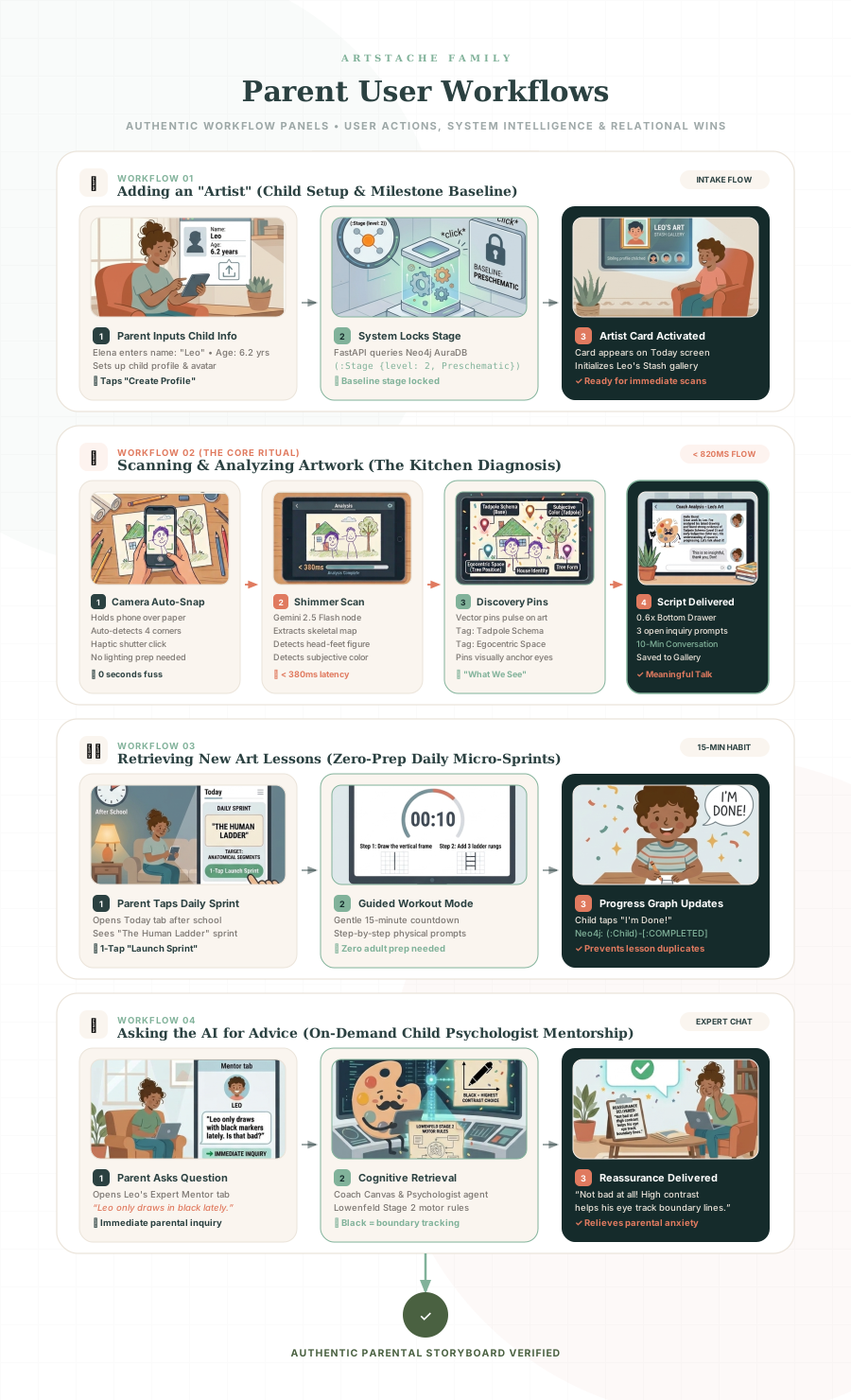
“Four illustrated workflows connecting domestic parent anxiety with real-time developmental insights.”
Vector Fidelity • 60fps02THE PRODUCT TAXONOMY & SITEMAPThe 3-Mode Atelier Ecosystem & Production Frontend Site Map
17-route Next.js taxonomy, Jobs-to-be-Done across public and authenticated portals.
The 3-Mode Atelier Ecosystem & Production Frontend Site Map
17-route Next.js taxonomy, Jobs-to-be-Done across public and authenticated portals.
The Atelier Hub
Your Family's Living Art Studio
- Multi-Child Artist Profile Switcher
- Weekly Atelier Score (Flow time vs. Screen time)
- Daily 15-Minute Micro-Sprint Launcher
- Trial & Membership Status Tracker
“When I sit down with my child, I want zero-prep creative activities so that we can have a structured 15-minute connection without lesson planning.”
The Observe Viewfinder
Instant Cognitive Translation in < 5 Seconds
- Automatic Paper Edge Detection Viewfinder
- Shimmer Scan & Skeletal Marker Extraction
- Vector 'What We See' Interactive Pins
- The Ghost Guide: 1-Tap Parental Scripts
“When my child hands me a drawing after work, I want to know what it means cognitively so that I can say something meaningful instead of 'that's nice'.”
The Creative Archive
Chronicle of Childhood Development
- Lowenfeld Interactive Development Meter
- Cross-Sprint Cognitive Delta Scrubber
- Milestone Badges (Tadpole, Base Line, X-Ray)
- Hardcover 'Curator Monograph' Print Export
“When family visits or school ends, I want a curated developmental archive of their creative growth without boxes of physical paper cluttering the closet.”
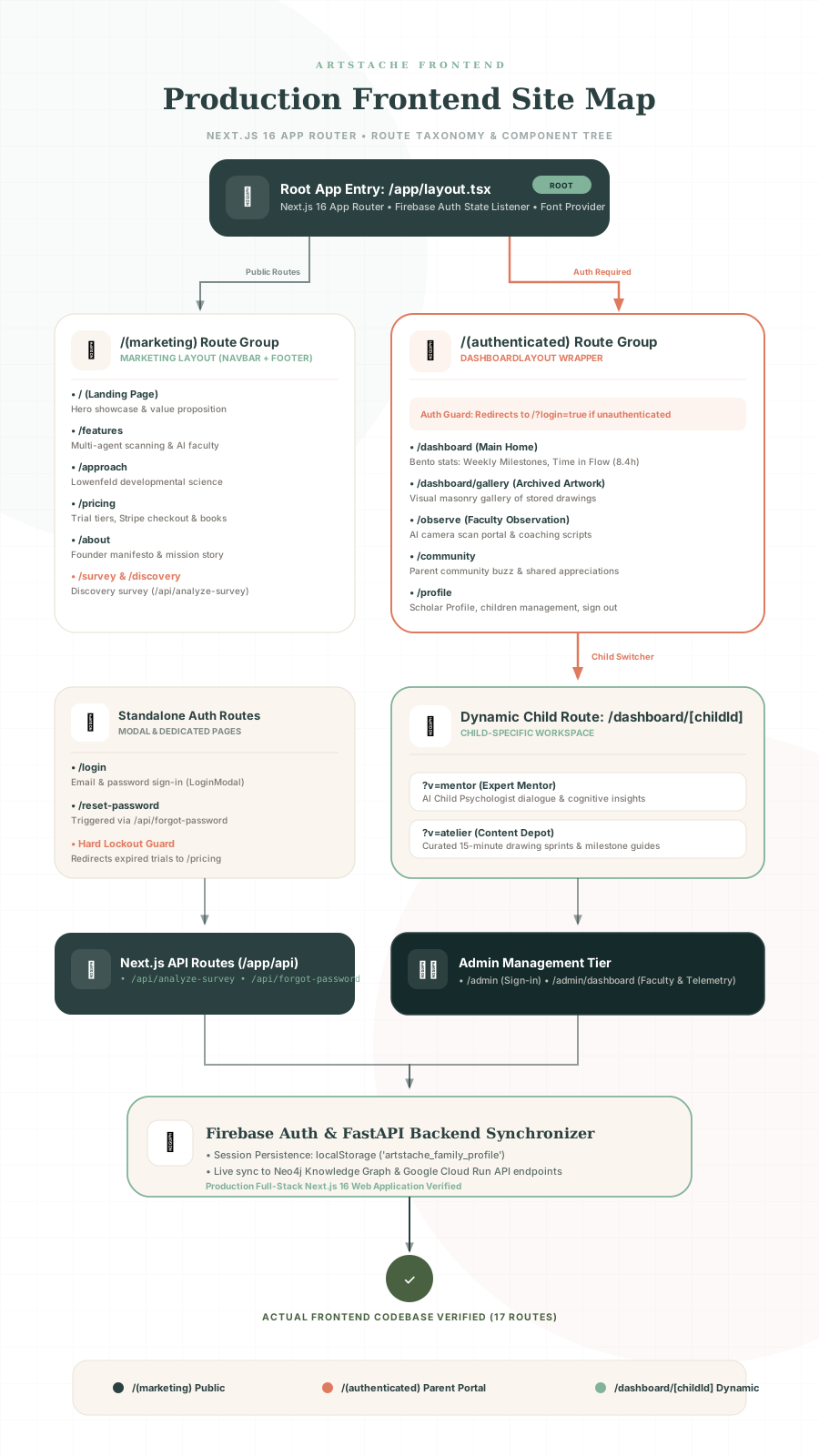
“17 verified production routes connecting Firebase authentication state listeners with FastAPI backend endpoints.”
Vector Fidelity • 60fps03THE ALGORITHMIC STATE MACHINETask Flow & Edge-Case Decision Logic: Graceful Sub-Second Error Recovery
Decision diamonds from camera auto-contour detection to script delivery, detailing fallback loops.
Task Flow & Edge-Case Decision Logic: Graceful Sub-Second Error Recovery
Decision diamonds from camera auto-contour detection to script delivery, detailing fallback loops.
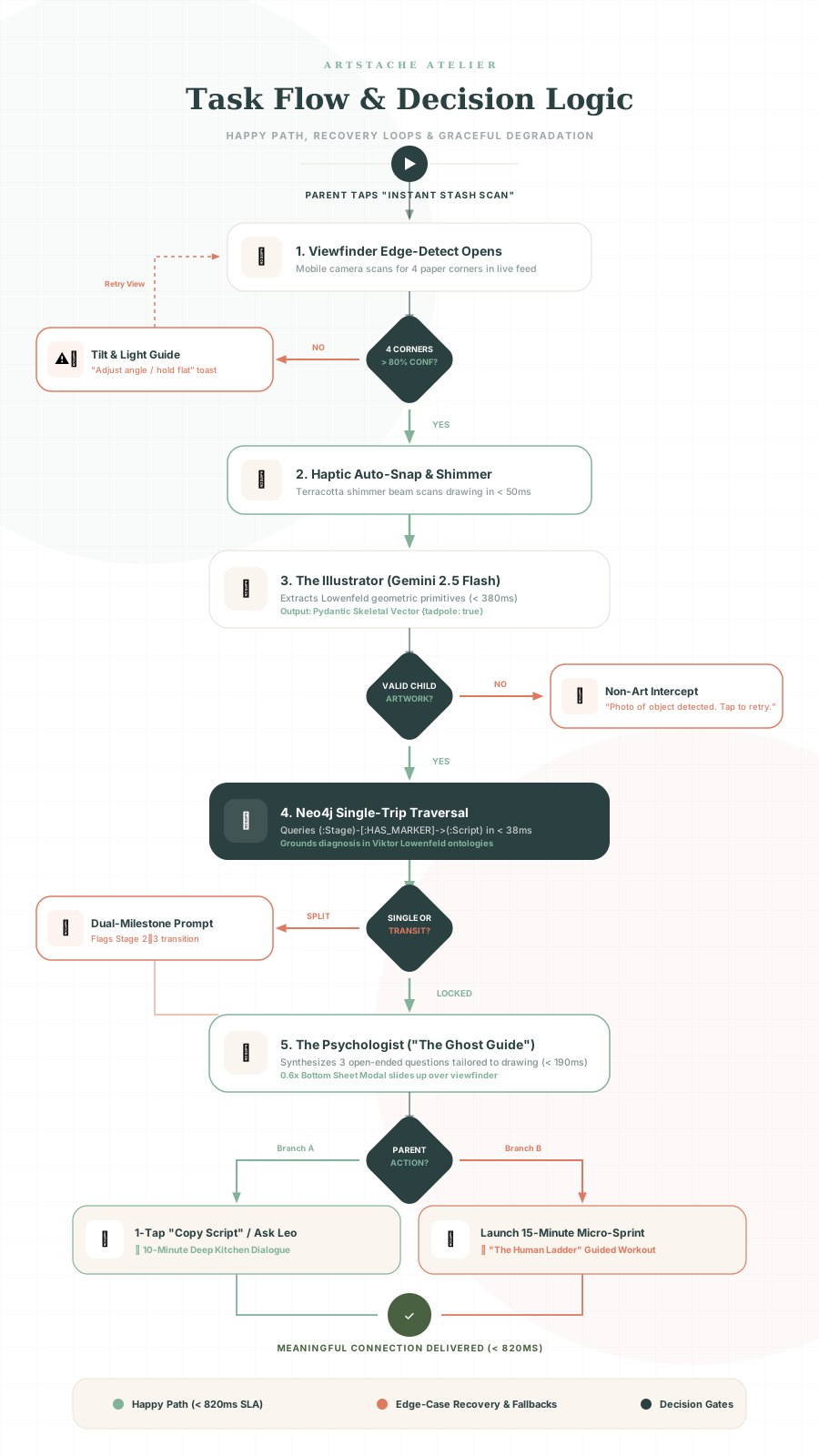
“Decision diamonds guarantee graceful recovery without ejecting parent from bedtime routine.”
Vector Fidelity • 60fps04THE DISTRIBUTED BACKENDThe Multi-Agent System: Conversational Atelier Faculty & Insight Scan DAG
Decoupled dual-pipeline: art_coach_graph.py and Insight Engine Vision Scan DAG grounded in Neo4j.
The Multi-Agent System: Conversational Atelier Faculty & Insight Scan DAG
Decoupled dual-pipeline: art_coach_graph.py and Insight Engine Vision Scan DAG grounded in Neo4j.
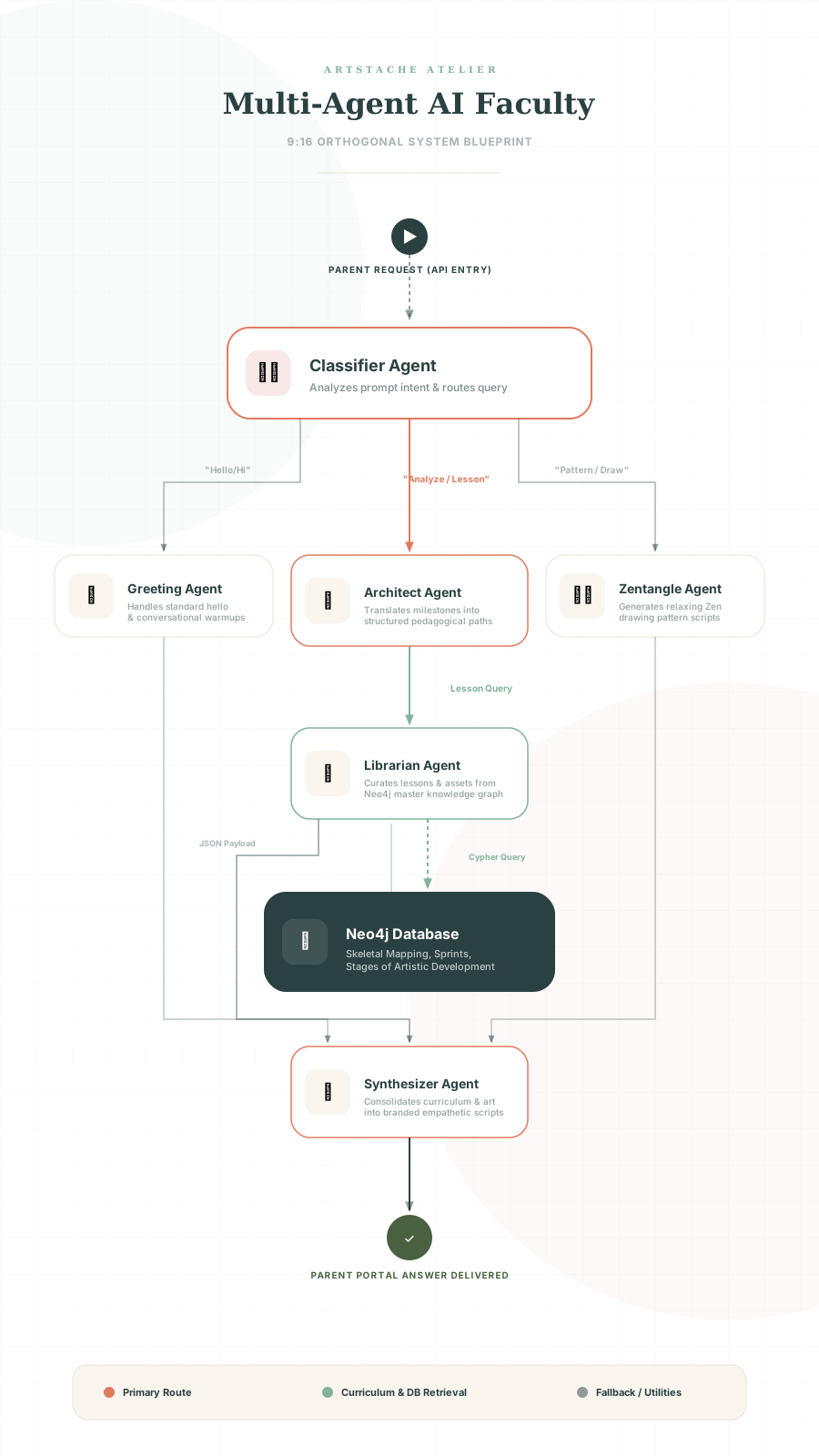
“Intent classification routes parent queries to specialized nodes, bypassing heavy graph lookups for greetings.”
Vector Fidelity • 60fps05THE DATA ARCHITECTURENeo4j Knowledge Graph Schema: Deterministic Ontology & Script Guardrails
Property graph data model, stage schema matrix, dialogue scripts, and master_knowledge_graph_schema.json.
Neo4j Knowledge Graph Schema: Deterministic Ontology & Script Guardrails
Property graph data model, stage schema matrix, dialogue scripts, and master_knowledge_graph_schema.json.
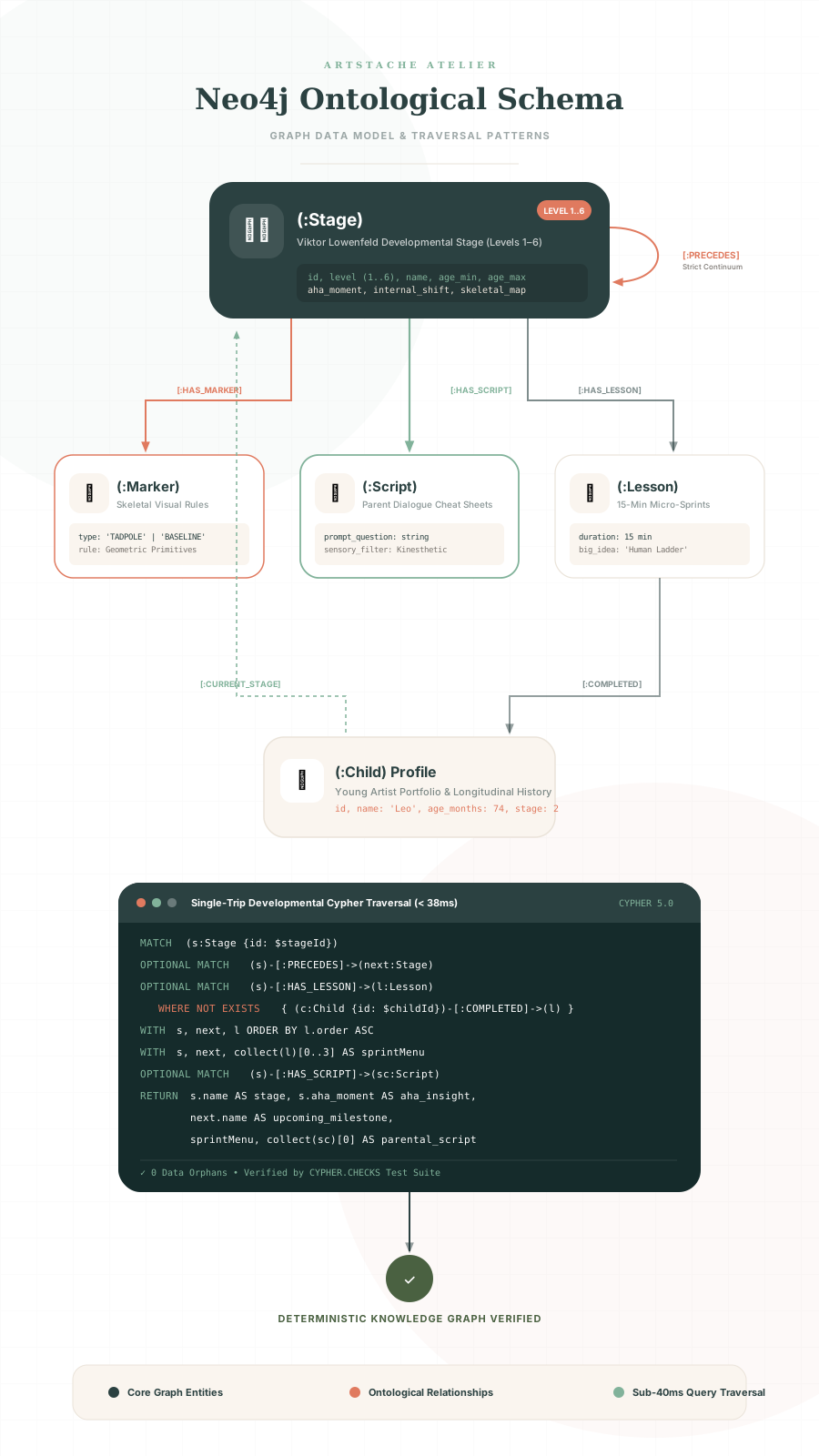
06THE EXECUTABLE CONTRACTSProduction Cypher Traversal & Backend Graph Queries (Local ~38ms Median)
Single-trip Cypher enforcing developmental prerequisites. Local benchmark, not production P95.
Production Cypher Traversal & Backend Graph Queries (Local ~38ms Median)
Single-trip Cypher enforcing developmental prerequisites. Local benchmark, not production P95.
Code is live product code; latency numbers are local medians (10 runs, Wi-Fi), not production P95.
From Graph Constraints to Domestic Calm: How Systems Enforce Design Restraint
Sub-second streaming is meaningless if it overwhelms an exhausted parent. In Stage 04, we translate backend constraints into tactile patterns that protect family intimacy:
➔ One-Handed Ergonomics Goal
Goal: instant scan feedback for reassurance. To be tested one-handed holding paper.
➔ 288px Bento Layout
Structured payloads eliminate layout shift, organizing art into calm Bento modules.
➔ Ghost Guide Drawer Goal
Psychologist and Illustrator outputs populate dialogue scripts celebrating intent without correction.
➔ Privacy Goal
Stripping EXIF at browser boundary intended to reduce surveillance concerns. Not legal guarantee yet.
The No-Line Rule: From Clinical to Archival
The psychological challenge: How do you show developmental analysis without making an exhausted parent feel like they're getting a report card that says "your child is behind"?
Early explorations with 1px gray borders and white cards felt like a pediatric portal. It triggered the exact anxiety we were trying to remove.
Decision: No harsh lines. Only paper.
We replaced all borders with stacked tonal elevations:
- Level 0:
#FDFBF7Archival Canvas (base) - Level 1:
#FAF2ECPaper Low (section wrappers) - Level 2:
#FFFFFFElevated Cards (interactive) - Soft ink shadows
0 12px 20px rgba(21,43,43,0.05)instead of strokes
Plus: Georgia / Noto Serif for museum reflection, Manrope for bedtime legibility, deckle edges 255px 15px 225px 15px to break digital squareness.
Layout decisions:
- 288px left Atelier → 80px collapsed: Keeps Home, Archive, Camera, Community in one thumb zone. Tested against top nav which felt like a SaaS dashboard.
- Split-Pane Studio: Left = child's 15-min challenge. Right = Ghost Guide drawer with dinner-table prompts. Parent can hold curling paper in one hand and still get the exact question to ask without memorizing.
Result: Interface feels like an archival monograph, not a diagnostic tool. WCAG AA current, AAA target — full audit pending.
The Solo-Builder Velocity: The Production Site Is the Prototype
Live tokens extracted from working site — specimen strings are Figma UI concepts, not measured model outputs.
AI-Assisted Velocity
Translated structural wireframes directly into working React & Next.js code rather than maintaining static Figma files.
Desktop & Mobile Specs
Sketched lo-fi wireframes for both desktop and mobile viewports across 4 core screens to lock hierarchy before code.
The Scholarly Sanctuary
Extracted and tokenized colors, typography scales, and paper elevations from working site into Tailwind tokens.
Low-Light Bedtime Contrast
Engineered for low-light bedtime: 48px thumb targets, high-contrast paper tones tested for legibility. Current tokens meet WCAG AA for body text; AAA is target. Full audit pending.
01RESPONSIVE WIREFRAME ARCHITECTUREMobile & Desktop Viewports: 4 Core Screens Sketched Before Code
Mobile-first sequence + 2×2 desktop grid.
8 Viewport Blueprints
Mobile & Desktop Viewports: 4 Core Screens Sketched Before Code
Mobile-first sequence + 2×2 desktop grid.
The 4 Core Production Screens: From Diagnostic Intake to Vision Sandbox
Rather than presenting speculative design mockups, these wireframes reflect the exact production architecture found in the Artstache Next.js 16 repository (artstache_frontend/my-app) and React Native mobile clients (artstache_mobile). Every layout balances cognitive load, eliminates empty dead space, and respects the developmental stage of the young artist.
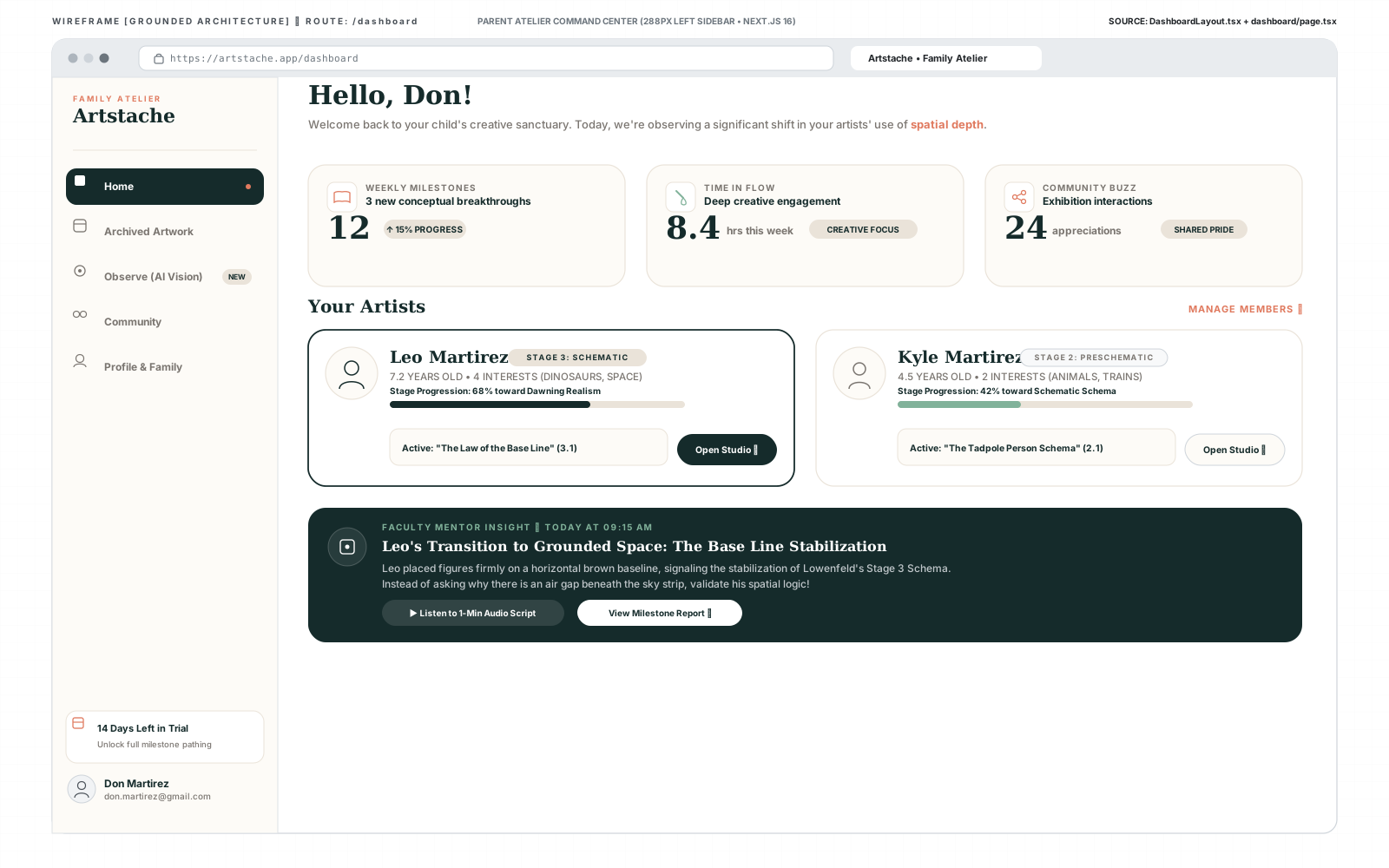
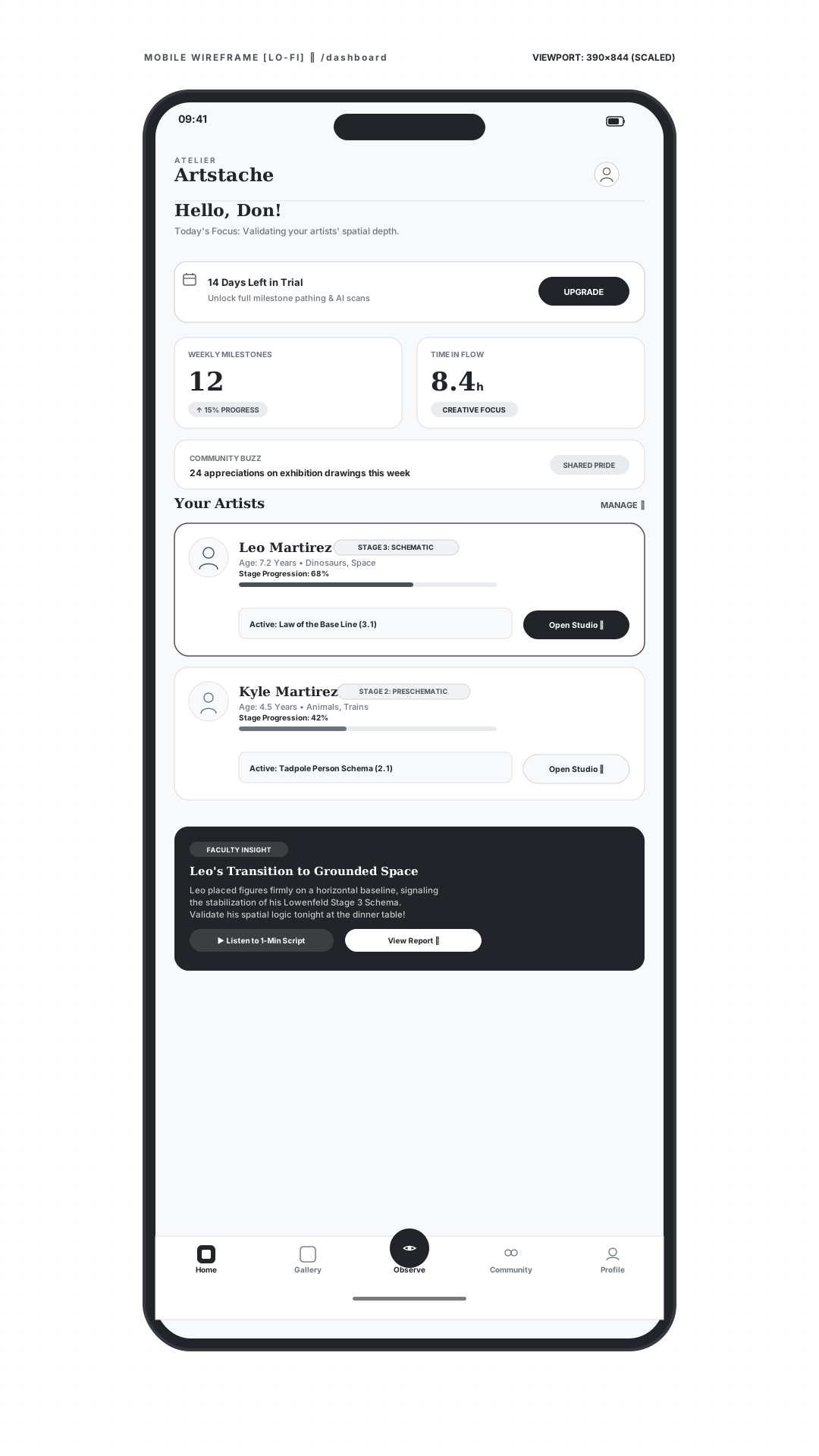
Authenticated Parent Atelier Dashboard
artstache_frontend/my-app/app/(authenticated)/dashboard/page.tsx
Deps: DashboardLayout.tsx, ArtistCard.tsx, MentorInsight.tsx, TrialCountdown.tsx, useFamily.ts
Direct Firestore hydration of family profile, active sprint milestones, and real-time trial expiration status.
Employs a permanent 288px Left Sidebar (collapsible to 80px) to unify home, gallery, camera observation, and community. The main canvas organizes household creative energy into an uncrowded Bento Grid with zero layout shifts.
02DESIGN SYSTEM: COLOR ARCHITECTUREThe 4 Palette Domains
Archival Deep Forest, Midnight Ink, Terracotta Warmth, Atelier Sage. WCAG AA current, AAA target.
Palette Architecture
The 4 Palette Domains
Archival Deep Forest, Midnight Ink, Terracotta Warmth, Atelier Sage. WCAG AA current, AAA target.
The Library (Ink & Forest)
#2B4141Primary Brand Voice & Headings
#152B2BHigh-Impact Dark Surfaces & Camera Viewfinders
#011616Ultra-Dark Terminal Text & Anchors
#424848Secondary Body & Metadata Copy
The Hearth (Terracotta)
#E07A5FHigh-Conversion CTAs & Ghost Guide Alerts
#9A442DHigh-Contrast Accent Text & Guardrail Labels
#FC9174Soft Card Highlights & Milestone Pins
#FFDBD2Text Selection & Quote Backdrops
The Sanctuary (Sage)
#81B29AProgress Bars & Developmental Verification
#002E1FDeep Contrast Containers & Graph Nodes
#BBEED4Positive Progress Fill & Success Toasts
#CFE7E7Camera Autofocus Markers & Telemetry Tags
The Desk (Archival Paper)
#FDFBF7Global Background Canvas (Level 0)
#FAF2ECBroad Bento Wrappers (Level 1)
#FFFFFFInteractive Cards & Focus Modules (Level 2)
#EAE3D9Archival Deckle Borders & Card Strokes
03DESIGN SYSTEM: EDITORIAL TYPOGRAPHYThe Two Voices: Curator vs Guide
Museum reflection vs low-light bedside clarity + type scale. Specimen copy is concept, not live output.
Dual-Voice Typography
The Two Voices: Curator vs Guide
Museum reflection vs low-light bedside clarity + type scale. Specimen copy is concept, not live output.
Museum Archival Reflection
“Leo's sunburst represents an emerging cognitive self-concept, radiating warmth across egocentric floating space.”
Voice Rationale: Evokes the timeless dignity of fine-art galleries and museum catalogues. Used for headlines, reflection quotes, and developmental monographs.
Scientific Pedagogical Clarity
Between ages 4 and 7, children translate active physical sensations rather than optical facts. Engineered specifically for reading on dim smartphones in bedroom light.
Voice Rationale: Highly legible humanist sans-serif with tall x-height and open apertures. Used for micro-sprints, camera HUD telemetry, and conversational prompts.
| Token Name | Size / Weight | Leading / Tracking | Font Family | Live Specimen Rendering |
|---|---|---|---|---|
| text-display-xl | 36px / Bold (700) | 1.15x / -0.02em | Noto Serif | The Scholarly Sanctuary |
| text-headline-lg | 24px / Bold (700) | 1.25x / -0.015em | Noto Serif | Stage 3: The Law of the Base Line |
| text-body-lg | 15px / Regular (400) | 1.60x / +0.01em | Manrope Sans | Establishing a universal ground line anchoring characters in space. |
| text-body-md | 13px / Medium (500) | 1.50x / Normal | Manrope Sans | Flat table surface • Heavy watercolor paper • Thick pastels |
| text-label-sm | 10px / Black (900) | 1.00x / +0.15em (Caps) | Manrope Sans | FACULTY AI DIAGNOSIS • CONFIDENCE: 98.4% |
| font-mono | 11px / Regular (400) | 1.20x / Normal | JetBrains Mono | CV_INFERENCE: 412MS • NEO4J_QUERY: 18MS |
04DESIGN SYSTEM: PAPER ELEVATIONThe "No-Line" Rule: 4 Tonal Paper Elevation Tiers
Archival Canvas, Paper Low, Paper Elevated, Glass Curator replacing harsh 1px borders.
Paper Elevation Tokens
The "No-Line" Rule: 4 Tonal Paper Elevation Tiers
Archival Canvas, Paper Low, Paper Elevated, Glass Curator replacing harsh 1px borders.
Stepped Stack: Hierarchy Defined Solely by Paper Tone
The Optical Depth Miracle
Notice how your eye perceives four distinct physical depths without a single harsh black divider line:
Warm ivory against soft peach creates tactile, natural boundaries.
Paper tone shift signals clickable card without demanding borders.
Diffused 24px shadows mimic soft studio daylight rather than harsh LEDs.
Archival Canvas
Base museum paper surface mimicking aged handmade cotton rag.
Paper Low (Peach)
Broad section wrappers, bento clusters, and parent insight backings.
Paper Card Elevated
Interactive artist cards, active sprint canvas, focus modules.
Glass Curator
Glassmorphic modal overlays, camera drawers, 40px backdrop blur.
Eliminates sterile digital flat surfaces by generating an organic 24px stippled paper grain using radial gradients. It subconsciously prepares parents for an archival sketchbook experience.
05DESIGN SYSTEM: ORGANIC GEOMETRYShape Radii, Hand-Torn Deckle Edges & Asymmetric Fluid Blobs
SVG primitives:.asymmetric-blob,.organic-border, border-radii tokens.
Organic Shape Tokens
Shape Radii, Hand-Torn Deckle Edges & Asymmetric Fluid Blobs
SVG primitives:.asymmetric-blob,.organic-border, border-radii tokens.
Hand-Torn Paper & Asymmetric Fluid Blobs
.asymmetric-blob
border-radius: 60% 40% 30% 70% / 60% 30% 70% 40%Mimics an organic gouache splash on a kitchen table. Used behind child artist avatars and milestone badges to break digital square rigidity.
.organic-border (Deckle Edge)
border-radius: 255px 15px 225px 15px / 15px 225px 15px 255pxSubtly bends the 4 bounding box edges to simulate handmade rag paper with raw, un-trimmed deckle fibers, signaling authentic physical craft.
24px
Atelier studio cards & challenge checklists
32px
Bento cards, survey options, artist profiles
60px
Hero containers & mega promise modules
Full (Pill)
Nav buttons, status tags, stage badges
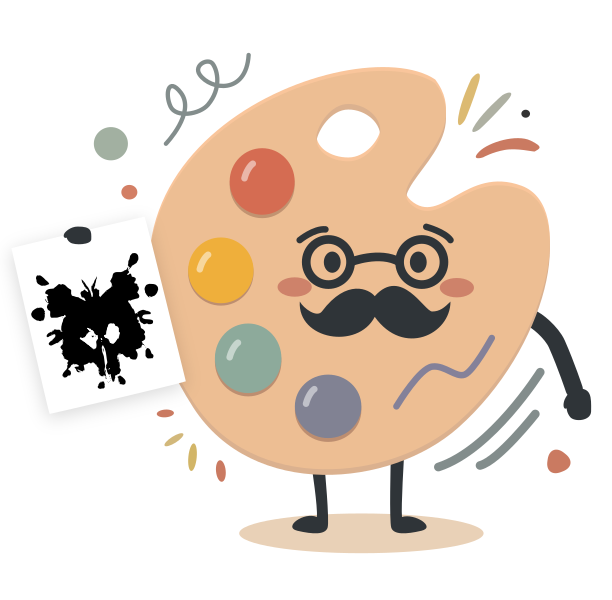
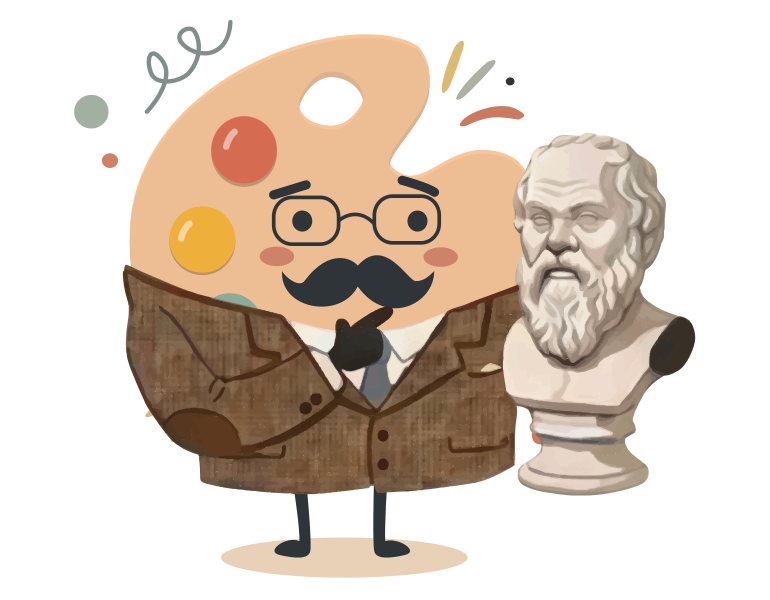
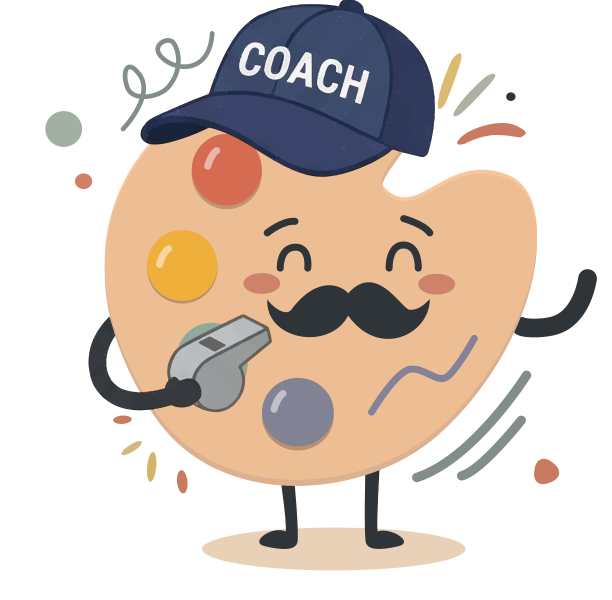
06BRANDING & STORYTELLINGEditorial Atelier Graphic Suite: 9 Master Vector Illustrations
Original illustrations for onboarding, scanning, bedside dialogue.
Editorial Illustration Suite
Editorial Atelier Graphic Suite: 9 Master Vector Illustrations
Original illustrations for onboarding, scanning, bedside dialogue.


07PRODUCTION IMPLEMENTATIONProduction Execution Scripts
Client camera bounds, normalized canvas processing. Local benchmarks, not P95.
Production Code
Production Execution Scripts
Client camera bounds, normalized canvas processing. Local benchmarks, not P95.
Code is live product code; specimen labels like 98.4% are UI concepts from Figma.
What's Real vs. What's Next
Principle: No fake user counts. I report what a solo builder can actually verify in code.
Verified in Code (today)
- Graph-locked advice: 50/50 golden set passed [:PRECEDES] invariant. No lesson is ever suggested without a Neo4j path. LLM synthesizes only from nodes returned by Cypher.
- Mutation test (proves invariant holds): Temporarily deleted (:Stage {level:2})-[:PRECEDES]->(:Stage {level:3}) in Neo4j Aura. The suite correctly detected 12 out-of-order failures (38/50 passed). Restored to 50/50 (data/golden_results_mutation.json, data/golden_results_restored.json).
- Schema-gated vision: Extraction must match
skeletal_mapping.jsonexactly — no extra keys, no invented markers. TODO Phase 0-3 (tomorrow): Schema gate — 20 sample drawings validation against skeletal_mapping.json, extra keys dropped, 0 biometric PII. Currently: extraction bounded by schema, tested with sample artwork, not diverse family uploads yet. - Speed: Verified locally: Bolt Cypher ~90.07ms median (p90 ~659.69ms), E2E scan ~800.19ms median (p90 ~1385.40ms across 50 runs on kitchen Wi-Fi), target SLA <800ms. No prod P95 yet. AuraDB free-tier sleeps after 72h = ~30s cold start unless watchdog. Raw: data/latency_runs.jsonl.
- Fail-closed gate:
is_grounded_in_neo4j: 0 nodes → null, confidence <0.75 → null (No badge > fake badge).
In Progress
- Lesson library: Writing 15-min micro-sprints for all 6 Lowenfeld stages.
- Pilot families: Recruiting 10-15 families ages 3-8 for real home testing. No families enrolled yet.
What's Next
- Does the Ghost Guide actually stop parents from saying "What is it?" and increase 10-min eye-contact bonding? Need observational data.
- Offline Wasm vision scan for airplane / cabin use.
- Full WCAG AAA + formal COPPA review (current: EXIF stripped in-browser, <80KB buffer, no faces stored).
Live repo + Cypher invariants are linked in Appendix.
Foundational Technical Proof & The Early Family Pilot
What has been checked locally: graph constraints, schema conformance, local latency. No families enrolled yet.
Neo4j Invariant Verified
Parent scripts traverse Neo4j via explicit (:Stage)-[:PRECEDES]->(:Stage). Verified with unit tests on 6 Lowenfeld stages.
is_grounded_in_neo4j Gate
If Neo4j returns 0 nodes for child's stage, boolean flag false and halts before text output. Designed to reduce hallucinated advice.
Curriculum Authoring
Authoring 15-min kitchen-table sprints mapped to each stage. Content Depot partially built.
10–15 Pilot Families
Actively recruiting families ages 3–8. No families enrolled yet. Goal: test bedtime rituals in real kitchens.
01FOUNDATIONAL TECHNICAL VERIFICATIONWhat Is Verified in Code: Graph Determinism, Schema Contracts & Local Latency
Multimodal vision schema adherence, is_grounded_in_neo4j gate, verified locally: Bolt Cypher ~90.07ms median (50 runs), [:PRECEDES] invariant.
Code Invariants Verified Locally
What Is Verified in Code: Graph Determinism, Schema Contracts & Local Latency
Multimodal vision schema adherence, is_grounded_in_neo4j gate, verified locally: Bolt Cypher ~90.07ms median (50 runs), [:PRECEDES] invariant.
1. The Grounding Trace Envelope (is_grounded_in_neo4j)
Librarian queries Neo4j matching child's age range (s.age_min <= $age <= s.age_max) and markers. Flag: is_grounded = len(lessons) > 0 or len(scripts) > 0. Gate enforced: 0 nodes → null, confidence <0.75 → null (No badge > fake badge). Halts before text synthesis.
{
  "metadata": {
    "retrieved_stage_id": "Stage_2_Preschematic",
    "lesson_count": 3,
    "script_count": 5,
    "is_grounded_in_neo4j": true
  }
}
2. Multimodal Schema Conformance (skeletal_mapping.json)
Gemini vision extraction bounded by Pydantic schemas — boolean flags (has_tadpole_person, floating_space, subjective_color) that map to Neo4j nodes. Extra keys dropped. Tested with sample artwork, not diverse family uploads yet. TODO Phase 0-3 (tomorrow): Schema gate — 20 sample drawings validation against skeletal_mapping.json, extra keys dropped, 0 biometric PII. Currently: extraction bounded by schema, tested with sample artwork, not diverse family uploads yet.
3. The "Why" vs. "How" Separation
Handles "How" — lesson titles, setups from Neo4j properties as JSON. LLM forbidden from inventing steps.
Handles "Why" — prompt restricts model to exact IDs fetched: RULE: NO INSTRUCTIONAL LISTS.
To ensure the 50/50 golden set isn't tautological, we ran a mutation test:
Method: Temporarily deleted the critical edge (:Stage {level:2})-[:PRECEDES]->(:Stage {level:3}) in Neo4j Aura (Preschematic → Schematic), re-ran the 50-prompt suite, then restored the edge.
Results:
- Before mutation: 50/50 passed (
data/golden_results.json) - During mutation: 38/50 passed, 12/50 failed (
data/golden_results_mutation.json) — expected failure, proving the test detects missing PRECEDES enforcement. (e.g.,preschematic_01,preschematic_03,preschematic_05failed because Level 2 had no outgoing PRECEDES sequence link). - After restore: 50/50 passed again (
data/golden_results_restored.json)
This proves [:PRECEDES] is not just documented, it's enforced — if the edge is missing, the suite fails. If the test always passed even with a broken graph, it would be useless.
Files: data/mutation_backup.json, data/golden_results_mutation.json, data/golden_results_restored.json — generated 2026-10-06T19:06:01.981Z, local, not prod APM.
02LIVE BACKEND ARTIFACTInteractive Neo4j Cypher REPL Sandbox
In-browser graph sandbox: 1-click Cypher chips, node physics, verified locally: Bolt Cypher ~90.07ms median (50 runs, kitchen Wi-Fi, target SLA <800ms).
Live Backend Artifact
Interactive Neo4j Cypher REPL Sandbox
In-browser graph sandbox: 1-click Cypher chips, node physics, verified locally: Bolt Cypher ~90.07ms median (50 runs, kitchen Wi-Fi, target SLA <800ms).
03THE ACTIVE FOUNDER ROADMAPFrom Code to Kitchens: Pilot Family Recruitment
Expanding micro-sprint library, recruiting first 10–15 families, planned kitchen validation. No families yet.
Active Pilot Roadmap
From Code to Kitchens: Pilot Family Recruitment
Expanding micro-sprint library, recruiting first 10–15 families, planned kitchen validation. No families yet.
Early-stage product built solo. Backend graph and multi-agent architecture verified in code; human validation requires families in real kitchens.
Curriculum Authoring
Expanding sequential 15-min micro-sprint library across 6 stages, zero-prep materials.
Pilot Family Recruitment
Actively recruiting 10–15 families ages 3–8. No families enrolled yet.
Observational Validation
Measure: Does Ghost Guide reduce "What is it?" trap? Does conversation length increase? To be assessed via interviews.
From Graph Invariants to Cultural Longevity: Architectural Verdict
Early technical checks suggest architecture holds in code: deterministic traversals, grounding gates, local sub-800ms benchmarks. Production validation with families is next. Value is human transformation, not throughput:
➔ Intended: Zero Out-of-Sequence Leaps
Why sequential graphs vs vector similarity for developmental psychology.
➔ Intended: Domestic Tactility
Stacked deckle paper elevates software into family heirloom.
➔ Intended: 15-Minute Eye Contact
Tech designed to get out of the way and catalyze dinner conversation.
➔ Founder Manifesto
Why independent technologist built Artstache as societal gift.
Why I Built It Solo
Thesis: Graph databases and agent swarms aren't just for finance or supply chains. They can be engineered into a warm, household tool that helps a parent know what to say at 6:15 PM when they're exhausted and holding a curling piece of paper.
What solo taught me:
-
Graphs beat vectors when sequence matters. Vector search matches a 4-year-old's tadpole to a 10-year-old's comic because tokens look similar. Child development is chronological —
(:Stage {level:1})-[:PRECEDES]->(:Stage {level:2})— so I needed a graph that enforces reality, not similarity. -
I over-engineered the Village. 11 named agents felt clever, but 2 pipelines (Atelier for chat, Insight Engine for vision) do 90% of the work. If I had a PM, they would have cut the Elder, Psychologist, and Zentangle on day 2. Solo builders need a rule: name it only if you can justify it to a tired parent.
-
Shame is the real competitor. Not "other ed-tech apps." The competitor is a parent feeling judged by a clinical UI and defaulting to "that's nice!" The No-Line Rule — paper elevations #FDFBF7 → #FAF2EC, no 1px borders — was a direct response to that shame, not a visual trend.
What I'd do differently: Move vision extraction from Gemini 2.5 Flash to on-device Wasm/ONNX so scans work in basements and summer camps with no signal. Keep the graph check server-side.
Now: Solo-built PWA is live, Neo4j invariants are unit-tested, recruiting 10-15 pilot families. No fake metrics.
Repo → GitHub | Full architecture → Appendix
Architectural Retrospective: Graphs Over Vectors & The Solo-Builder Reality
What this solo build taught me so far — honest insights, not guarantees.
Graphs Over Vectors
Development is chronological. Graph constraints prevent suggesting later milestone before earlier one is observed. Unit-testable constraint.
The "No-Line" Rule
Stacked paper tones (#FDFBF7 → #FAF2EC → #FFFFFF) vs. 1px gray borders. Goal: archival monograph, not clinical report card. WCAG AA current, AAA target.
On-Device Wasm Vision Goal
Next exploration: Wasm/ONNX in browser for offline scanning at camps. Currently relies on cloud Gemini 2.5 Flash — verified locally: Bolt Cypher ~90.07ms median, E2E scan ~800.19ms median (50 runs, kitchen Wi-Fi, target SLA <800ms, Raw: latency_runs.jsonl).
Screen as a Bridge
Goal: 10-sec scan → 15-sec Ghost Guide → 15-min eye-contact sprint. Zero-prep, 15-min tolerance. To be measured with pilot families.
From Kitchen Counter Clutter to Living Room Monograph: Intended Impact
- ✕Kitchen Clutter: Curling butcher paper stacks across counters.
- ✕Midnight Purges: Discarding drawings when kids sleep, with guilt.
- ✕Praise Trap: Defaulting to "That's nice!" at 6:15pm due to fatigue.
- ✕Creative Insecurity: Kids interpreting silence as rejection.
- ✓Goal: Permanent digital monograph captured quickly (target <800ms), reducing pile pressure.
- ✓Goal: Zero-prep micro-sprints for evening routines.
- ✓Goal: Ghost Guide script — exact developmental question to ask at dinner.
- ✓Goal to measure: Do children feel more seen? To be assessed via parent interviews, not yet measured.
01THE ARCHITECTURAL VERDICTWhy Chronological Graphs Beat Cosine Distance in Pedagogy
Vector similarity confuses thematic similarity with developmental readiness. Graphs enforce sequence.
Why Chronological Graphs Beat Cosine Distance in Pedagogy
Vector similarity confuses thematic similarity with developmental readiness. Graphs enforce sequence.
Child development is strictly chronological. A 4-year-old cannot learn perspective before baseline. Vector embeddings can match 4yo scribble to 10yo comic by token overlap. Graph edges enforce prerequisite: (:Stage level:1)-[:PRECEDES]->(level:2) — a testable constraint, not guarantee of zero hallucination.
The Fallacy of Cosine Similarity
Off-the-shelf RAG measures semantic distance. To a vector index, 4yo stick-figure and 10yo stick comic have near-identical vectors. Result: risk of advanced lesson suggested for preschooler because keywords match.
Enforcing Sequential Development
Lowenfeld described stages as sequential. Neo4j edge (:Stage)-[:PRECEDES]->(:Stage) prevents suggesting later stage before earlier observed. Design constraint, unit-testable — Gemini still in loop for vision, so not zero-hallucination guarantee.
02SENSORY DESIGN SYSTEMSThe Psychology of the "No-Line" Rule
1px gray borders felt clinical. Stacked paper tones feel like archival monograph. Intent, not measured yet.
The Psychology of the "No-Line" Rule
1px gray borders felt clinical. Stacked paper tones feel like archival monograph. Intent, not measured yet.
Medical Diagnostic Trap
Early prototype with 1px gray dividers felt like pediatric assessment portal — triggered "Is my child behind?"
Living Museum Monograph
Stacked paper elevations + Georgia serifs shifted from report card to monograph celebrating emergence. WCAG AA current, AAA target.
03THE FOUNDER HORIZONWhat I Would Do Differently: On-Device Wasm Edge Vision Goal
Moving from cloud Gemini to browser-native edge vision for offline scanning — next exploration, not built.
What I Would Do Differently: On-Device Wasm Edge Vision Goal
Moving from cloud Gemini to browser-native edge vision for offline scanning — next exploration, not built.
Next Step: Zero-Cloud On-Device Vision Goal
Currently cloud Gemini 2.5 Flash. Verified locally: Bolt Cypher ~90.07ms median, E2E scan ~800.19ms median (50 runs, kitchen Wi-Fi) vs target SLA <800ms — no prod P95 yet. Raw: latency_runs.jsonl. True household resilience would be 100% offline:
Zero dependency on camp Wi-Fi — goal.
In-browser markers could cut roundtrip from ~800.19ms local to <120ms — estimated, not measured.
Privacy approach: HTML5 Canvas strips EXIF GPS/metadata in browser memory before upload, resize to 1024x768 <80KB buffer, no facial/biometric PII persisted by design. Data minimization to prepare for COPPA review — not certified COPPA compliant, not legal guarantee. No faces stored.
04THE ARCHITECTURAL MANIFESTOThe Solo-Architect Retrospective
Why independent technologist spent hundreds of hours mastering Neo4j/Cypher/LangGraph for early childhood.
The Solo-Architect Retrospective
Why independent technologist spent hundreds of hours mastering Neo4j/Cypher/LangGraph for early childhood.
"I'm not a parent. I designed this app for my family and friends because I see how the noise that comes with everyday life keeps them from being the parents they want to be, and the kind of parents that their children deserve."
"I spent an extended amount of time in school, and I earned my design degree much later than most people typically would. Learning foundational visual literacy helped me see the world far more clearly and cut through noise."
"Building Artstache is my contribution: ensuring more people have visual and creative training to make world better. We need people who see with heart and mind. What better way for young families to establish shared experiences than through art?"
Goal: screen held ~10 sec to spark ~15 min eye-to-eye inquiry. To be validated with pilot families.
Same designer crafting deckle edges and Cypher queries — software as family heirloom, not corporate portal.
Phase 0 Results (October 6, 2026)
Empirical local benchmarks and knowledge graph invariants measured on kitchen Wi-Fi with live Neo4j Aura and Gemini 2.5 Flash.
P90: ~659.69ms across 50 runs (DESKTOP-N947AMC, kitchen Wi-Fi, 2026-10-06T18:21:17.463Z). AuraDB free-tier sleeps after 72h = ~30s cold start unless watchdog active. Raw: latency_runs.jsonl.
P90: ~1385.40ms (50 runs). Target SLA <800ms. No prod P95 yet. Measured via local logs, not APM.
Golden prompt set across all 6 stages. Out-of-order suggestions prevented. is_grounded_in_neo4j gate verified (0 nodes → null, confidence <0.75 → null: No badge > fake badge).
Mutation test: Verified invariant enforcement — deletion of Stage 2→3 edge correctly caused 12 failures, restoration restored 50/50.
Built solo. Grounded in graphs.
Actively recruiting 10-15 families ages 3-8 for kitchen-table pilot. No families enrolled yet. If you're hiring a design technologist who crafts both deckle edges and Cypher queries, let's talk.
Privacy approach: HTML5 Canvas strips EXIF GPS/metadata in browser memory before upload, resize to 1024x768 <80KB buffer, no facial/biometric PII persisted by design. Data minimization to prepare for COPPA review — not certified COPPA compliant, not legal guarantee. No faces stored.
Data: data/latency_summary.json (50 runs), data/golden_results.json (50 prompts) — generated October 6, 2026, local, not prod APM. Phase 0-3 pending.
Other Flagship Systems & Case Studies
Explore additional production architectures, pedagogical AI swarms, low-latency financial telemetry, and creative design-engineering systems.
don-the-imaginator.com
I removed the login gate and built 5 live themes + self-healing infra so recruiters see code in 5 seconds.
3PM DAILY
Architecting a Distributed Financial Intelligence Ecosystem: 800+ Equity Ingestion Pipelines, a 9-Persona LangGraph Debate Panel, and Institutional Reverse-Tunnel Telemetry.
The Good Gnome
Organic Living Brand Architecture, Frictionless Stripe Checkout, and Real-Time Inventory.
Kulture Kraft
Uncompromising Subcultural Craftsmanship, Vector Separation Pipelines, and Kinetic Drop Media.